
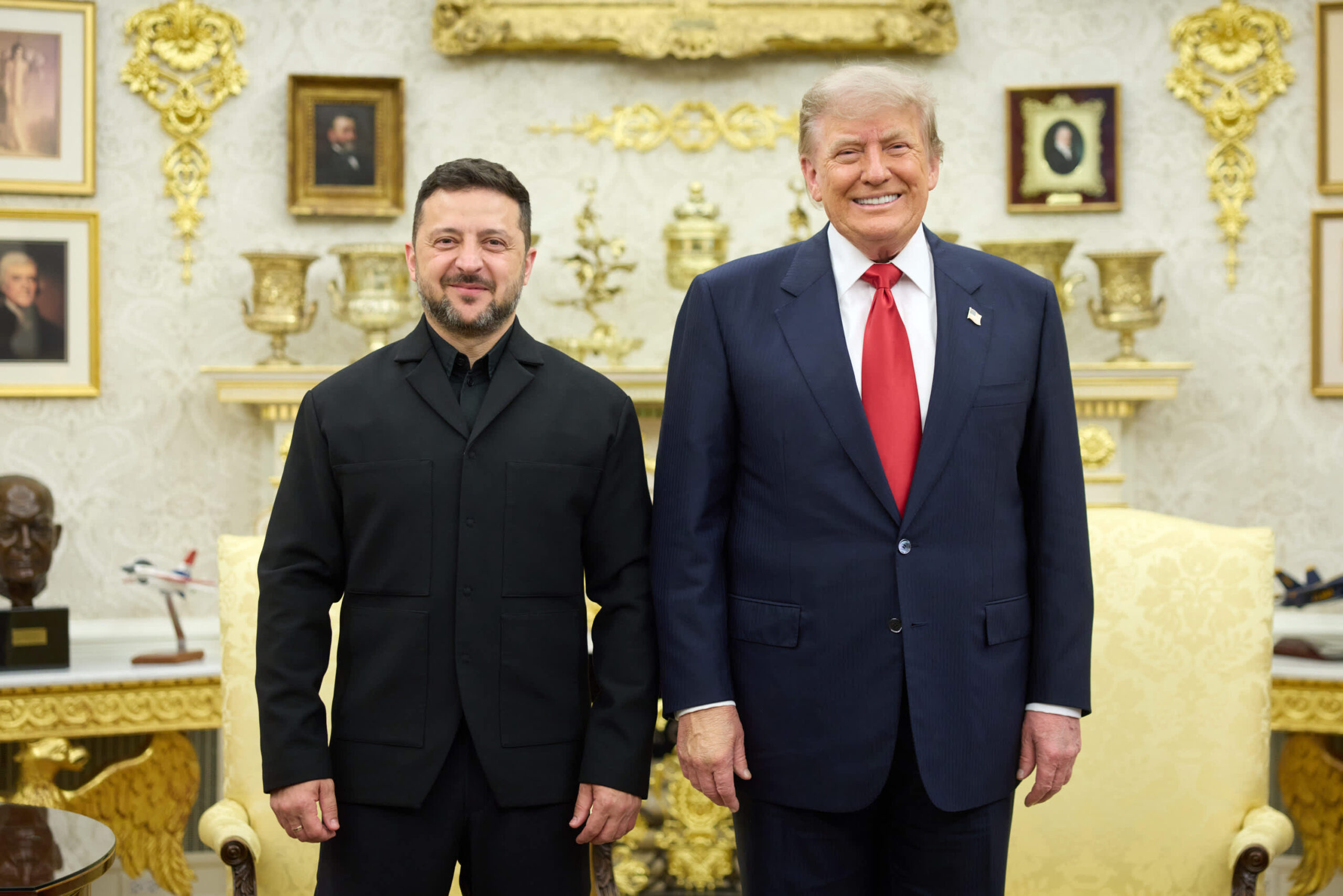

Ukrainian President Volodymyr Zelenskyy is at the White House on Tuesday for talks with President Donald Trump, as he looks to shore up support for Kyiv at a time when the Russia and Iran conflicts have shown signs of converging.
The meeting comes as the U.S war against Iran and Russia’s full-scale invasion of Ukraine reach critical junctures. Trump has paused airstrikes against Iran as part of a push to give diplomacy another chance, while Zelenskyy has been galvanized by a flurry of deep-strike successes on Russian territory.
The meeting represents a chance for Zelenskyy to further improve his relationship with Trump, roughly 17 months on from an Oval Office meeting that unraveled into an extraordinary shouting match.
The visit also coincides with a renewed congressional push to tighten sanctions on Moscow. The Senate is scheduled to hold a procedural vote Tuesday evening on legislation championed by the late Sen. Lindsey Graham that would target Russia and countries that continue buying its energy exports.
The bipartisan measure would impose tariffs on goods from some of the largest buyers of Russian oil and natural gas, including China and India. It would also sanction Russian President Vladimir Putin, senior political and military officials, financial institutions and major energy projects.
Zelenskyy is expected to meet with senators Tuesday evening after Graham’s funeral, the reason Zelenskyy traveled to Washington.
Despite the action on Capitol Hill, there appears to be no immediate end in sight to the global conflicts. In fact, the sprawling Middle East war has threatened to overlap with the Russia-Ukraine conflict in recent days.
Kyiv on Saturday launched an attack on an Iranian commercial vessel in the Caspian Sea, an incident which Tehran said left one sailor dead and injured several others. The Islamic Republic has threatened retaliation over the strike, with Foreign Minister Abbas Araghchi saying via social media that it “CANNOT GO UNANSWERED.”
In a post on X on Saturday, Zelenskyy said Ukraine had “achieved very strong results with long‑range strikes in the Caspian Sea – including vessels used in military cargo shipments involving Iran, as well as a warship.”
Christopher Granville, managing director at TS Lombard, described Ukraine’s attack on an Iranian vessel in the Caspian Sea as a “very significant” development.
“The Ukrainian President Volodymyr Zelenskyy has himself spoken of these strikes with satisfaction and justified them on the grounds that Ukrainian intelligence has evidence that Russian intelligence is helping Iran with targeting U.S. military sites in neighboring Middle Eastern countries,” Granville told CNBC’s “Europe Early Edition” on Monday.
“It’s a collision of these wars. It’s a merger. I think fundamentally this is very significant. Militarily how significant it is remains, of course, to be seen, but Iran has said in its public statement that it will hit back and that Ukraine has made a mistake which it will regret,” he added.
Ukrainian authorities may be calculating that Iran has its hands full with its war with the U.S., Granville said, “but as it happens, the military exchanges between [the] U.S. and Iran have died down in the last two or three days. So, yeah, it’s a big deal.”
Wars becoming ‘increasingly intertwined’
Ukraine’s foreign minister, Andrii Sybiha, on Monday described Iran’s threats of retaliation as “unjustified and groundless.”
The regime in Tehran “is a direct accomplice to Russian aggression against Ukraine, fuelling Moscow’s criminal war with weapons that have killed Ukrainians since 2022,” Sybiha said via X, referring to the start of Russia’s war against Ukraine.
Russia has long used Iranian-designed Shahed drones in its war on Ukraine, a weapon that analysts sometimes refer to as “the poor man’s cruise missile.”
Hamidreza Azizi, an expert on Iranian security and visiting fellow at Berlin-based think tank SWP, said that at the political level, Iran could respond to Ukraine’s attack by recognizing Crimea and the Donbas as parts of Russian territory, areas occupied by Russia that Tehran has so far refused to endorse.
“In any case, what is clear is that Iran’s war is becoming increasingly intertwined with two other conflicts: the Saudi-Houthi confrontation and the Russia-Ukraine war,” Azizi said Sunday in a social media post.
“With each passing day, the war is evolving into an increasingly complex, multidimensional, and international conflict, he added.
— CNBC’s Azhar Sukri contributed to this report.
By CNBC