
The head and neck squamous cell carcinoma market is experiencing significant growth, driven by the rising incidence of head and neck cancers worldwide, increasing adoption of immunotherapies, targeted therapies, and combination treatment approaches. Additionally, the expected launch of emerging therapies such as Amivantamab (RYBREVANT) (Johnson & Johnson), BNT113 (BioNTech), CUE-101 (Cue Biopharma), Petosemtamab (MCLA-158) (Genmab), Eftilagimod Alfa (Immutep), and others will further propel the market growth.
New York, USA, July 13, 2026 (GLOBE NEWSWIRE) — Head and Neck Squamous Cell Carcinoma Market is Projected to Boost at a CAGR of 10.5% During the Forecast Period (2026–2036) Due to the Launch of Emerging Novel Immunotherapies | DelveInsight
The head and neck squamous cell carcinoma market is experiencing significant growth, driven by the rising incidence of head and neck cancers worldwide, increasing adoption of immunotherapies, targeted therapies, and combination treatment approaches. Additionally, the expected launch of emerging therapies such as Amivantamab (RYBREVANT) (Johnson & Johnson), BNT113 (BioNTech), CUE-101 (Cue Biopharma), Petosemtamab (MCLA-158) (Genmab), Eftilagimod Alfa (Immutep), and others will further propel the market growth.
Recently published Head and Neck Squamous Cell Carcinoma Market Insights report includes a comprehensive understanding of current treatment practices, head and neck squamous cell carcinoma emerging drugs, market share of individual therapies, and current and forecasted market size from 2022 to 2036, segmented into leading markets [the United States, the EU4 (Germany, France, Italy, and Spain), the United Kingdom, and Japan].
Head and Neck Squamous Cell Carcinoma Market Summary
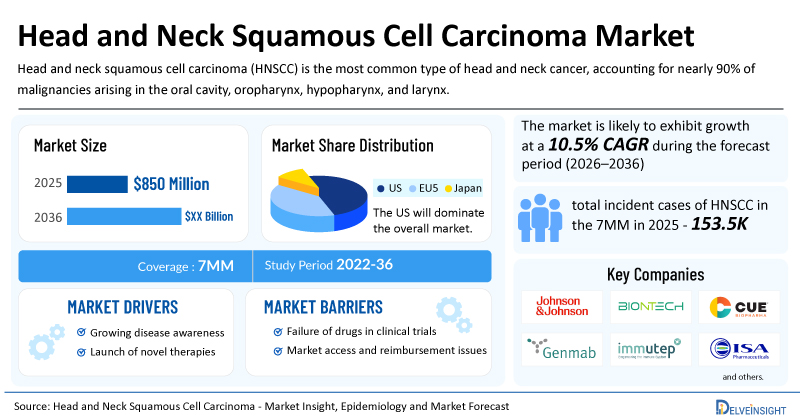
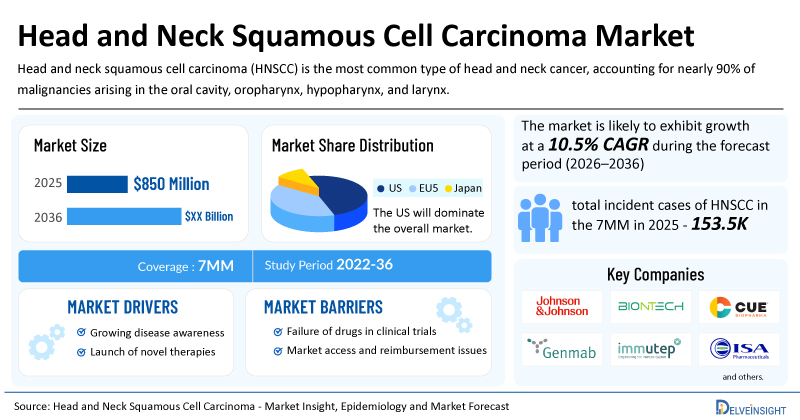
- The market size for head and neck squamous cell carcinoma was found to be USD 850 million in the 7MM in 2025.
- The United States accounted for the largest head and neck squamous cell carcinoma treatment market size in 2025, compared to other major markets, including the EU4 countries (Germany, France, Italy, and Spain), the United Kingdom, and Japan.
- In 2025, among all the therapies for HNSCC, the highest revenue is estimated to be generated by KEYTRUDA in the United States.
- The total incident cases of HNSCC in the 7MM were approximately 153,500 in 2025.
- Key head and neck squamous cell carcinoma companies, including Johnson & Johnson, BioNTech, Cue Biopharma, Genmab, Immutep, ISA Pharmaceuticals, PDS Biotechnology, Nykode Therapeutics, Inovio Pharmaceuticals, and others, are actively working on innovative HNSCC drugs.
- Some of the key HNSCC therapies in clinical trials include Amivantamab (RYBREVANT), BNT113, CUE-101, Petosemtamab (MCLA-158), Eftilagimod Alfa, ISA101, Versamune HPV, abipapogene suvaplasmid, INO-3112, and others. These novel HNSCC therapies are anticipated to enter the head and neck squamous cell carcinoma market in the forecast period and are expected to change the market.
Discover head and neck squamous cell carcinoma market growth opportunities @ https://www.delveinsight.com/report-store/head-and-neck-squamous-cell-carcinoma-market
Key Factors Driving the Growth of the Head and Neck Squamous Cell Carcinoma Market
- Rising Incidence of Head and Neck Cancers: The increasing prevalence of head and neck cancers, driven by risk factors such as tobacco use, alcohol consumption, and HPV infection, is expanding the patient pool and driving demand for effective treatment options.
- Growing Adoption of Immunotherapy: The success of immune checkpoint inhibitors has transformed the treatment landscape for recurrent and metastatic HNSCC, encouraging broader adoption and fueling market growth.
- Advancements in Targeted Therapies: The development of novel targeted agents directed at EGFR, PI3K, and other molecular pathways is improving treatment outcomes and creating new commercial opportunities.
- Increasing Focus on Precision Medicine: Advances in biomarker testing and molecular profiling are enabling personalized treatment approaches, enhancing therapeutic efficacy and supporting the uptake of innovative therapies.
- Expanding Clinical Trial Activity: A robust pipeline of investigational therapies, including Amivantamab (RYBREVANT) (Johnson & Johnson), BNT113 (BioNTech), CUE-101 (Cue Biopharma), Petosemtamab (MCLA-158) (Genmab), Eftilagimod Alfa (Immutep), ISA101 (ISA Pharmaceuticals), Versamune HPV (PDS Biotechnology), abipapogene suvaplasmid (Nykode Therapeutics), INO-3112 (Inovio Pharmaceuticals), and others are currently under different stages of development.
Aparna Thakur, project manager of forecasting at DelveInsight, said that the growing integration of immune checkpoint inhibitors and novel combinations, such as pembrolizumab with HPV-targeted vaccines, underscores a key advancement in HNSCC management.
Head and Neck Squamous Cell Carcinoma Market Analysis
- The current standard of care for locoregionally advanced HPV16-positive HNSCC typically involves chemoradiotherapy (CRT) or surgical resection followed by adjuvant treatment. Nevertheless, patients with advanced disease continue to face substantial risks of recurrence and metastatic progression.
- Although CRT has demonstrated strong efficacy in earlier-stage disease, its long-term effectiveness is often hindered by treatment resistance, disease relapse, and persistent toxicities, particularly among patients with recurrent HPV16-positive tumors.
- Among immunotherapy options, KEYTRUDA and OPDIVO are the leading PD-1 inhibitors approved for recurrent or metastatic (R/M) HNSCC.
- KEYTRUDA monotherapy is widely used as a first-line treatment for patients with high PD-L1 expression; however, response rates remain limited at approximately 20%, with no clear advantage observed based on HPV status. Notably, no therapies are currently approved specifically for HPV16-positive malignancies.
- The effectiveness of PD-1 blockade in HPV-positive HNSCC is constrained by mechanisms of immune escape and an immunosuppressive tumor microenvironment. Emerging approaches, including E6/E7-targeted therapeutic vaccines and T-cell receptor (TCR)-based therapies, have shown encouraging but generally modest clinical activity. Their potential appears greater when used in combination regimens, although challenges such as Human Leukocyte Antigen (HLA) restrictions and resistance to antigen processing continue to limit broader applicability.
- Treatment options in the first-line recurrent/metastatic squamous cell carcinoma of the head and neck (R/M SCCHN) setting remain limited. For patients eligible for platinum-based therapy, the EXTREME regimen, comprising cetuximab, platinum chemotherapy, and 5-fluorouracil, has long served as a standard approach. However, clinical studies have reported only moderate survival improvements, with a median overall survival of around 10 months, while treatment-related toxicities remain a significant concern.
- Therapeutic cancer vaccines have gained increasing attention in HNSCC, with several candidates advancing through clinical development. Among them, ISA101b, PDS0101, and CUE-101 have demonstrated notable clinical potential and are considered among the most promising investigational therapies moving toward potential regulatory approval.
- The HPV16-positive HNSCC treatment landscape is becoming increasingly dynamic and competitive. Companies such as PDS Biotechnology, ISA Pharmaceuticals, Merus, BioNTech, and Cue Biopharma are advancing innovative therapeutic strategies aimed at enhancing treatment efficacy, overcoming resistance mechanisms, and expanding options for patients with HPV16-positive HNSCC, a population with considerable unmet medical needs.
Learn more about disease-modifying therapies for HNSCC @ Head and Neck Squamous Cell Carcinoma Treatment Market
Head and Neck Squamous Cell Carcinoma Competitive Landscape
Some of the HNSCC drugs under development include Amivantamab (RYBREVANT) (Johnson & Johnson), BNT113 (BioNTech), CUE-101 (Cue Biopharma), Petosemtamab (MCLA-158) (Genmab), Eftilagimod Alfa (Immutep), ISA101 (ISA Pharmaceuticals), Versamune HPV (PDS Biotechnology), abipapogene suvaplasmid (Nykode Therapeutics), INO-3112 (Inovio Pharmaceuticals), and others.
Genmab’s Petosemtamab is a low-fucose, full-length human IgG1 bispecific antibody developed using the BICLONICS platform, targeting both EGFR and Leucine-rich Repeat-containing G-protein-coupled Receptor 5 (LGR5). The therapy is engineered to exert antitumor activity through three distinct mechanisms: suppression of EGFR-mediated signaling pathways, induction of EGFR internalization and degradation following LGR5 engagement in tumor cells, and enhancement of immune-mediated tumor cell elimination via antibody-dependent cellular cytotoxicity (ADCC) and antibody-dependent cellular phagocytosis (ADCP).
Petosemtamab is currently being evaluated in the expansion phase of an open-label, multicenter Phase I/II study involving patients with advanced solid tumors, including previously treated recurrent or metastatic head and neck squamous cell carcinoma (HNSCC). An updated clinical data readout is anticipated in 2025. Additionally, the therapy has received Breakthrough Therapy Designation (BTD) from the FDA for second-line recurrent/metastatic HNSCC. Continued development of petosemtamab will require significant additional financial investment.
Immutep’s Eftilagimod alpha (Efti) is a soluble LAG-3 protein that functions as an MHC Class II agonist, designed to activate both innate and adaptive immune responses against cancer. As the first antigen-presenting cell (APC) activator in its class, Efti binds to MHC Class II molecules on APCs, triggering the activation and expansion of key immune cell populations, including CD8+ cytotoxic T cells, CD4+ helper T cells, dendritic cells, natural killer (NK) cells, and monocytes. The therapy also promotes the production of immune-stimulatory cytokines and chemokines, such as IFN-γ and CXCL10, further enhancing antitumor immunity. Efti has been granted Fast Track designation by the FDA for the treatment of first-line HNSCC.
The anticipated launch of these emerging HNSCC therapies are poised to transform the HNSCC market landscape in the coming years. As these cutting-edge HNSCC therapies continue to mature and gain regulatory approval, they are expected to reshape the HNSCC market landscape, offering new standards of care and unlocking opportunities for medical innovation and economic growth.
To know more about emerging head and neck squamous cell carcinoma therapies, visit @ Head and Neck Squamous Cell Carcinoma Medication
Recent Developments in the Head and Neck Squamous Cell Carcinoma Market
- In February 2026, the FDA granted breakthrough therapy designation (BTD) to amivantamab and hyaluronidase-lpuj (RYBREVANT FASPRO; subcutaneous amivantamab) as monotherapy for the treatment of adult patients with recurrent or metastatic, HPV–unrelated HNSCC following disease progression on or after platinum-based chemotherapy and a PD-L1 or PD-1 inhibitor.
- In August 2025, Merus announced that enrollment in the Phase III LiGeR-HN2 trial in HNSCC is expected to be completed by the end of 2025, and in May 2025, the company further announced that it anticipates sharing a topline interim readout in 2026 for Petosemtamab (MCLA-158).
- In August 2025, NHS England announced patients with advanced head and neck cancers in England will be fast-tracked into a trial of a new cancer vaccine, as the NHS expands its world-leading trial ‘match-making’ service.
- In May 2025, Merus announced interim clinical data as of February 27, 2025, data cutoff from the ongoing Phase II trial of the bispecific antibody petosemtamab in combination with pembrolizumab in 1L PD-L1+ R/M HNSCC. The data was further presented at ASCO 2025.
What is Head and Neck Squamous Cell Carcinoma
Head and neck squamous cell carcinoma (HNSCC) is the most common type of head and neck cancer, accounting for nearly 90% of malignancies arising in the oral cavity, oropharynx, hypopharynx, and larynx. It develops from the squamous epithelial cells lining the mucosal surfaces of the upper aerodigestive tract. Major risk factors include tobacco use, excessive alcohol consumption, and infection with human papillomavirus (HPV), particularly in oropharyngeal cancers. HNSCC is a heterogeneous disease characterized by varying molecular profiles, clinical presentations, and treatment responses. Management typically involves a multidisciplinary approach incorporating surgery, radiation therapy, chemotherapy, targeted therapies, and immunotherapies, depending on the stage and location of the tumor.
Head and Neck Squamous Cell Carcinoma Epidemiology Segmentation
The head and neck squamous cell carcinoma epidemiology section provides insights into the historical and current HNSCC patient pool and forecasted trends for the leading markets. It has been observed that among EU4 and the UK, site-specific cases of HNSCC were found maximum in the oral cavity in 2025.
The head and neck squamous cell carcinoma market report proffers epidemiological analysis for the study period 2022–2036 in the leading markets segmented into:
- Total Incident Cases of Head and Neck Cancer
- Total Incident Cases of HNSCC
- Site-specific Incident Cases of HNSCC
- HPV-positive Status-specific Incident Cases of HNSCC
- Stage-specific Incident Cases of HNSCC
- Total Treated Cases of HNSCC
Download the report to understand the future of HNSCC treatment @ Head and Neck Squamous Cell Carcinoma Treatment Options
| Head and Neck Squamous Cell Carcinoma Market Report Metrics | Details |
| Study Period | 2022–2036 |
| Head and Neck Squamous Cell Carcinoma Market Report Coverage | 7MM [The United States, the EU-4 (Germany, France, Italy, and Spain), the United Kingdom, and Japan] |
| Head and Neck Squamous Cell Carcinoma Market CAGR | 10.5% |
| Head and Neck Squamous Cell Carcinoma Market Size in 2025 | USD 850 Million |
| Key Head and Neck Squamous Cell Carcinoma Companies | Johnson & Johnson, BioNTech, Cue Biopharma, Genmab, Immutep, ISA Pharmaceuticals, PDS Biotechnology, Nykode Therapeutics, Inovio Pharmaceuticals, Bristol Myers Squibb, Merck Sharp & Dohme, and others |
| Key Head and Neck Squamous Cell Carcinoma Therapies | Amivantamab (RYBREVANT), BNT113, CUE-101, Petosemtamab (MCLA-158), Eftilagimod Alfa, ISA101, Versamune HPV, abipapogene suvaplasmid, INO-3112, OPDIVO, KEYTRUDA, and others |
Scope of the Head and Neck Squamous Cell Carcinoma Market Report
- Head and Neck Squamous Cell Carcinoma Patient Population Forecast
- Head and Neck Squamous Cell Carcinoma Therapeutics Market Size
- Head and Neck Squamous Cell Carcinoma Pipeline Analysis
- Head and Neck Squamous Cell Carcinoma Market Size and Trends
- Head and Neck Squamous Cell Carcinoma Market Opportunity
- Head and Neck Squamous Cell Carcinoma Market Unmet Needs
- KOL’s Views on Head and Neck Squamous Cell Carcinoma
- Head and Neck Squamous Cell Carcinoma Market Access and Reimbursement
Discover more about next-generation HNSCC drugs @ Head and Neck Squamous Cell Carcinoma Clinical Trials
Table of Contents
| 1 | Head and Neck Squamous Cell Carcinoma Market Key Insights |
| 2 | Head and Neck Squamous Cell Carcinoma Market Report Introduction |
| 3 | Executive Summary of Head and Neck Squamous Cell Carcinoma (HNSCC) |
| 4 | Key Events |
| 5 | Epidemiology and Market Forecast Methodology |
| 6 | Head and Neck Squamous Cell Carcinoma (HNSCC) Market Overview at a Glance |
| 6.1 | Clinical Landscape Analysis (By Phase, Molecule Type, and RoA) |
| 6.2 | Market Share (%) Distribution of HNSCC By Therapies in the 7MM, in 2025 |
| 6.3 | Market Share (%) Distribution of HNSCC By Therapies in the 7MM, in 2036 |
| 7 | Disease Background and Overview of Head and Neck Squamous Cell Carcinoma (HNSCC) |
| 7.1 | Introduction |
| 7.2 | Genomic Alterations and Key Pathways |
| 7.3 | Classification of HNSCC |
| 7.4 | Signs and Symptoms |
| 7.5 | Causes |
| 7.6 | Types of HPV in HNSCC |
| 7.7 | Diagnosis |
| 8 | Treatment Guidelines of Head and Neck Squamous Cell Carcinoma (HNSCC) |
| 9 | Epidemiology and Patient Population of Head and Neck Squamous Cell Carcinoma (HNSCC) |
| 9.1 | Key Findings |
| 9.2 | Assumptions and Rationale |
| 9.3 | Total Prevalent Cases of Head and Neck Squamous Cell Carcinoma (HNSCC) in the 7MM |
| 9.4 | The United States |
| 9.4.1 | Total Incident Cases of Head and Neck Cancer |
| 9.4.2 | Total Incident Cases of HNSCC |
| 9.4.3 | Site-specific Incident Cases of HNSCC |
| 9.4.4 | HPV-positive Status-specific Incident Cases of HNSCC |
| 9.4.5 | Stage-specific Incident Cases of HNSCC |
| 9.4.6 | Total Treated Cases of HNSCC |
| 9.5 | EU4 and the UK |
| 9.6 | Japan |
| 10 | Patient Journey of Head and Neck Squamous Cell Carcinoma (HNSCC) |
| 11 | Marketed Therapies of Head and Neck Squamous Cell Carcinoma (HNSCC) |
| 11.1 | Marketed Competitive Landscape of HNSCC |
| 11.2 | KEYTRUDA: Merck |
| 11.2.1 | Drug Description |
| 11.2.2 | Regulatory Milestones |
| 11.2.3 | Other Developmental Activities |
| 11.2.4 | Summary of Pivotal Trials |
| 11.2.5 | Clinical Development |
| 11.2.5.1 | Clinical Trial Information |
| 11.2.6 | Analyst Views |
| 11.3 | OPDIVO: Bristol Myers Squibb |
| List to be continued in the report… | |
| 12 | Emerging Drugs of Head and Neck Squamous Cell Carcinoma (HNSCC) |
| 12.1 | Emerging Competitive Landscape of HNSCC |
| 12.2 | Petosemtamab (MCLA-158): Merus N.V. |
| 12.2.1 | Drug Description |
| 12.2.2 | Other Developmental Activity |
| 12.2.3 | Clinical Development |
| 12.2.3.1 | Clinical Trials Information |
| 12.2.4 | Analyst Views |
| 12.3 | Amivantamab (RYBREVANT):Johnson & Johnson |
| List to be continued in the report… | |
| 13 | Head and Neck Squamous Cell Carcinoma Market: 7MM Analysis |
| 13.1 | Key Findings |
| 13.2 | Market Outlook of HNSCC |
| 13.3 | Key Market Forecast Assumptions |
| 13.4 | Conjoint Analysis of HNSCC |
| 13.5 | Total Market Size of HNSCC in the 7MM |
| 13.6 | Total Market Size of HNSCC by Therapies in the 7MM |
| 13.7 | The United States Head and Neck Squamous Cell Carcinoma Market |
| 13.7.1 | Total Market Size of HNSCC in the United States |
| 13.7.2 | Total Market Size of HNSCC by Therapies in the United States |
| 13.8 | EU4 and the UK Head and Neck Squamous Cell Carcinoma Market |
| 13.9 | Japan Head and Neck Squamous Cell Carcinoma Market |
| 14 | Unmet Needs of Head and Neck Squamous Cell Carcinoma (HNSCC) |
| 15 | SWOT Analysis of Head and Neck Squamous Cell Carcinoma (HNSCC) |
| 16 | KOL Views of Head and Neck Squamous Cell Carcinoma (HNSCC) |
| 17 | Market Access and Reimbursement of Head and Neck Squamous Cell Carcinoma (HNSCC) |
| 17.1 | The United States |
| 17.2 | EU4 and the UK |
| 17.3 | Japan |
| 17.4 | Summary and comparison of Market Access and Pricing Policy Developments in 2025 |
| 17.5 | Market Access and Reimbursement of HNSCC Therapies |
| 18 | Bibliography |
| 19 | Head and Neck Squamous Cell Carcinoma Market Report Methodology |
Related Reports
Recurrent Head and Neck Squamous Cell Carcinoma Clinical Trial Analysis
Recurrent Head and Neck Squamous Cell Carcinoma Pipeline Insight – 2026 report provides comprehensive insights about the pipeline landscape, pipeline drug profiles, including clinical and non-clinical stage products, and the key recurrent HNSCC companies, including AstraZeneca, Astellas, GlaxoSmithKline, Boehringer Ingelheim, Merck, and others.
HPV16+ Head and Neck Squamous Cell Carcinoma Market
HPV16+ Head and Neck Squamous Cell Carcinoma Market Insights, Epidemiology, and Market Forecast – 2036 report deliver an in-depth understanding of the disease, historical and forecasted epidemiology, market share of the individual therapies, and key HPV16+ HNSCC companies including Bristol Myers Squibb, Merck, Merus, Exelixis, ISA Pharmaceuticals, Regeneron Pharmaceuticals, PDS Biotechnology, BioNTech, Cue Biopharma, Immutep, Iovance Biotherapeutics, Inovio Pharmaceuticals, MedImmune, Nykode Therapeutics, RAPT Therapeutics, and others.
HPV16+ Cancers Market Insights, Epidemiology, and Market Forecast – 2036 report deliver an in-depth understanding of the disease, historical and forecasted epidemiology, as well as the market trends, market drivers, market barriers, and key HPV16+ cancers companies, including GlaxoSmithKline, PDS Biotechnology, Merck, Cue Biopharma, ISA Pharmaceuticals, Regeneron Pharmaceuticals, Vaccibody AS, Transgene, Innovio Pharma, Hookipa Pharma, Roche Pharma AG, Invectys, BioNTech, Advaxis, Inc., Precigen, and others.
HPV16+ Cancers Clinical Trial Analysis
HPV16+ Cancers Pipeline Insight – 2026 report provides comprehensive insights about the pipeline landscape, pipeline drug profiles, including clinical and non-clinical stage products, and the key HPV16+ cancers companies, including ISA Pharmaceuticals, Cue Biopharma, Genexine, Vaccibody AS, PDS Biotechnology, BlueSky Immunotherapies GmbH, and others.
Human Papillomavirus Market Insights, Epidemiology, and Market Forecast – 2036 report deliver an in-depth understanding of the disease, historical and forecasted epidemiology, as well as the market trends, market drivers, market barriers, and key HPV companies, including Inovio Pharmaceuticals, ISA Pharmaceuticals, Regeneron Pharmaceuticals, Merck, Pattern Pharma, Nykode, Vaccibody A/S, and others.
About DelveInsight
DelveInsight is a leading Business Consultant and Market Research firm focused exclusively on life sciences. It supports pharma companies by providing comprehensive end-to-end solutions to improve their performance. Get hassle-free access to all the healthcare and pharma market research reports through our subscription-based platform PharmDelve.
CONTACT: Contact Us Shruti Thakur info@delveinsight.com +14699457679
