
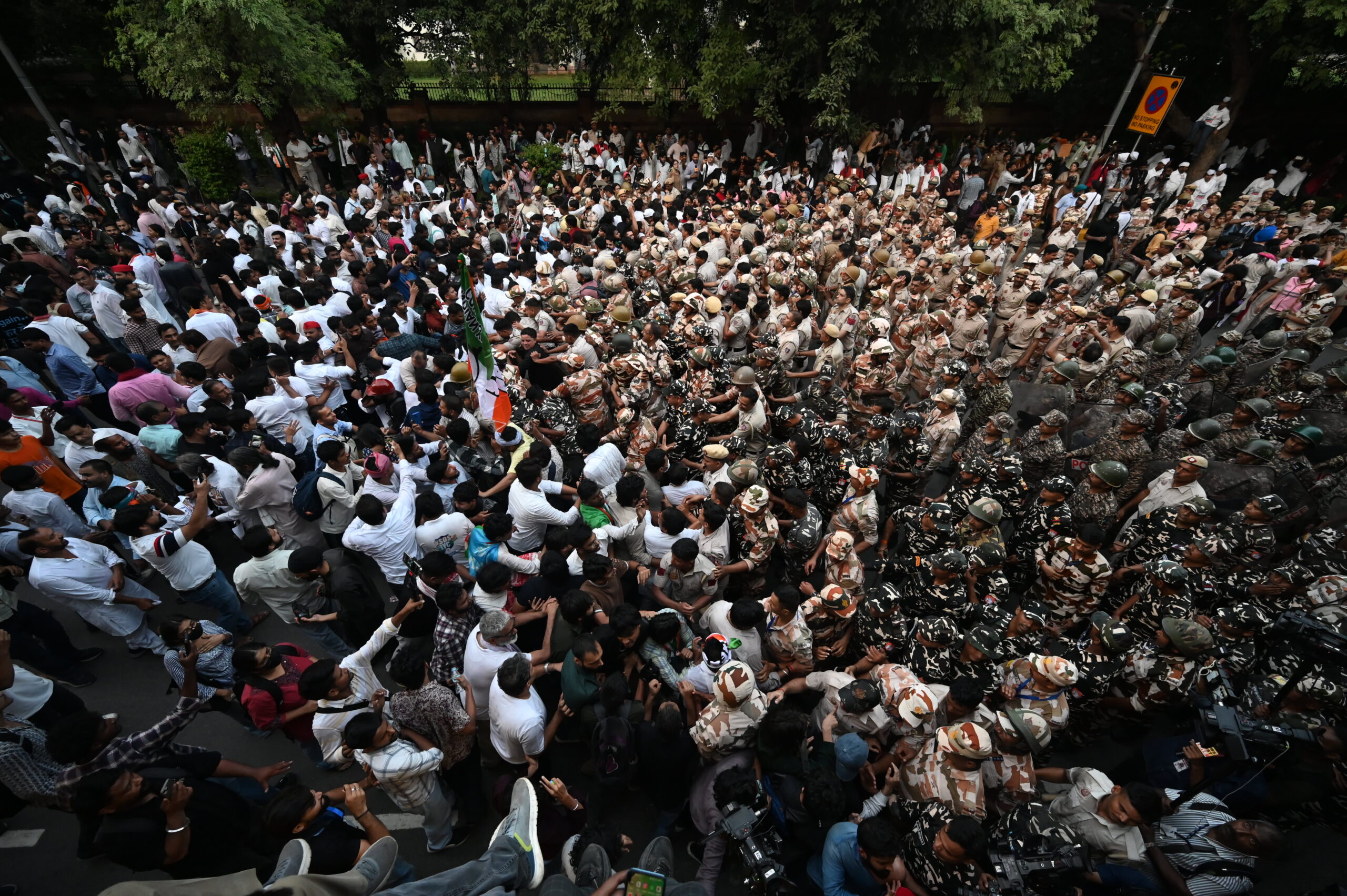

Prime Minister Narendra Modi on Tuesday defended India as a “mother of democracy,” as protests demanding the resignation of Chief Election Commissioner Gyanesh Kumar over alleged voter fraud are intensifying.
“A wide range of issues are debated openly, and diverse perspectives are discussed by the people,” Modi said, speaking at a Bloomberg New Economy event. His comments coincide with a severe crackdown by authorities against protestors demanding electoral reforms.
Earlier today, key members of the viral pseudo-political movement, Cockroach Janta Party, were detained for protesting without permission.
CJP, whose leaders were detained by authorities over the weekend as well, had sought permission from Delhi Police on Monday to launch fresh protests at the Jantar Mantar grounds in the capital. However, the government then barred the use of the site for protests.
On Monday, thousands of people reportedly joined leaders of Indian opposition parties in their march to the Supreme Court in Delhi to file a petition against revisions made to the voter list by the Election Commission.
Names of 130 million people have been struck off from the voter list after the commission began conducting “special intensive revisions” (SIR) to update voter lists across the country last year, as per several local media reports.
Rahul Gandhi, the leader of the opposition in India, said the huge crowds were a sign that people were not going to be “intimidated” by the government.
“There are no parallel protests. It’s one protest, and it’s a protest where everybody is standing together,” Gandhi said, dismissing concerns over the absence of members of the Cockroach Janta Party who had called for protests over the weekend.
“Delhi is once again flooded with people standing up to save democracy,” Abhijeet Dipke, the founder of the viral pseudo-political movement, CJP, said in a post, reacting to the crowd amassed for the march led by Gandhi.
Clampdown
Over the weekend, Indian security forces reportedly clamped down on protests in the capital city, detaining young people, several opposition party politicians, YouTubers, lawyers and a few journalists.
The Delhi police, which is under the control of the Indian home ministry, did not respond to an email seeking comments.
Experts told CNBC that while the scale of the protests does not pose a threat to the stability of India at present, crackdowns could broaden the unrest.
“If security forces keep taking heavy-handed approaches, this will create a more volatile environment that could make protestors angrier and galvanize even larger groups of marchers,” Michael Kugelman of the Atlantic Council told CNBC.
He added that at present the scale of the protests was not significant enough to impact “capital flow and investor behavior” but warned that “heavy-handed tactics that generate violence and volatility” by the state could change it.
The United Nations Human Rights Office on Saturday raised concerns over mass detentions and called on Indian authorities “to ensure that the right to peaceful assembly is fully respected and fulfilled.”
On Sunday, India’s Ministry of External Affairs responded to the UNHR’s comments, calling them “unwarranted” and claiming they constituted an “unacceptable interference in the internal affairs of India.”
‘Significant and massive’
The crackdown during the latest protest has been “significant and massive” compared to earlier reactions to farmers’ protests or uniform civil code protests, Arpit Chaturvedi, South Asia advisor at Teneo, told CNBC. He added that there is a higher chance that the broad-based retaliation to the police crackdown could lead to more demonstrations.
The CJP had first called for a nationwide protest on Oct. 2, seeking the removal of the election chief after an investigative report by the Indian Express showed discrepancies in the functioning of the Election Commission and reports of deletion of millions of voters.
On Sept. 26, following reports of the voter deletion, the Election Commission of India launched a special drive across India to enroll voters who have been left out of the rolls. It has downplayed discrepancies as highlighted in the Indian Express report and maintains it is “committed to ensuring that no eligible voter is left out of the voter list.”
However, Modi’s ruling party, the Bharatiya Janata Party, has defended the Election Commission and said the deletions were made on account of 28 million people who died, 68 million who relocated, 10 million with duplicate entries and 30 million absent or non-traceable voters.
The sweeping revisions of the electoral roll have raised serious constitutional and legal questions, Milan Vaishnav, director and senior fellow of the South Asia Program at Carnegie Endowment for International Peace, told CNBC.
The core demand of the movement is for Kumar to resign and for the commission to “seriously modify the so-called ‘Special Intensive Revision’ of the electoral rolls,” he said.
By CNBC